
SEO vs AEO: What's the Difference and Which One Actually Gets You Leads?
SEO and AEO are both essential for digital visibility in 2026, but they work differently. Here's how they compare and which generates more qualified leads.
SEO and AEO at a Glance
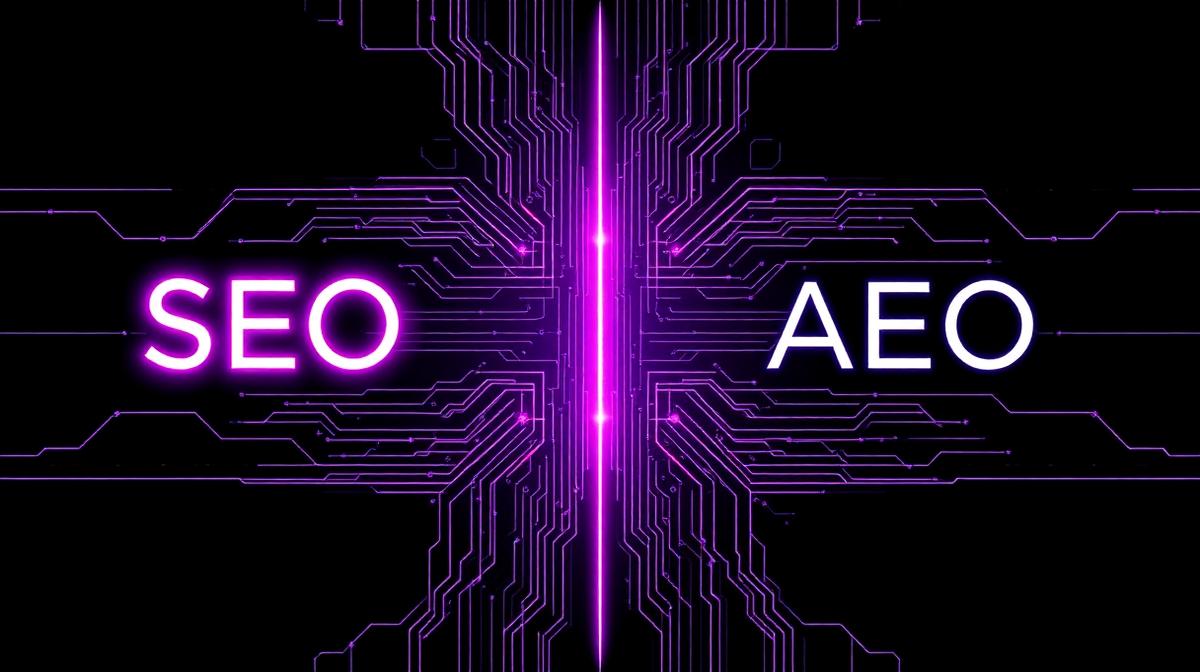
Search Engine Optimization (SEO) and Answer Engine Optimization (AEO) both aim to increase your digital visibility, but they target fundamentally different search experiences. Understanding the distinction is crucial for allocating your marketing resources effectively in 2026.
SEO focuses on ranking your website in traditional search engine results — the familiar list of blue links on Google, Bing, and other search engines. When someone searches for a keyword, SEO determines where your page appears in that list. The higher you rank, the more clicks you get.
AEO focuses on getting your brand cited in AI-generated answers — the responses produced by ChatGPT, Google AI Overviews, Perplexity, Microsoft Copilot, and other AI search tools. When someone asks an AI assistant a question, AEO determines whether your brand appears in the answer.
Both strategies are valuable. But as AI search grows to capture an ever-larger share of user queries, the question isn't which one to choose — it's how to effectively implement both.
How SEO Works in 2026
SEO in 2026 has evolved significantly from the keyword-stuffing days, but its core mission remains: help your pages rank higher in search engine results pages (SERPs). The practice encompasses three major pillars.
Technical SEO ensures search engines can discover, crawl, render, and index your content efficiently. This includes site architecture, page speed, mobile optimization, Core Web Vitals, SSL certificates, XML sitemaps, and crawlability management. Technical SEO is the foundation that everything else builds upon.
On-page SEO optimizes individual pages for specific search queries. This includes title tags, meta descriptions, heading structures, keyword usage, internal linking, image optimization, and content quality. On-page SEO helps search engines understand what each page is about and match it to relevant queries.
Off-page SEO builds the external signals that demonstrate authority and trustworthiness. Backlinks from authoritative sites, brand mentions, social signals, and digital PR all contribute to how search engines assess your domain's credibility.
In 2026, SEO also increasingly incorporates E-E-A-T (Experience, Expertise, Authoritativeness, Trustworthiness) as Google continues to prioritize content from credible sources. The bar for content quality has risen dramatically — thin, generic content struggles to rank regardless of technical optimization.
How AEO Works
AEO operates on a different model than SEO because AI answer engines function differently than traditional search engines. Instead of ranking pages, AI systems synthesize answers from multiple sources and present them as direct responses.
The AEO optimization process centers on three core mechanisms:
Entity optimization establishes your brand as a recognized, well-defined entity in AI knowledge systems. AI models need to understand who you are, what you do, and why you're credible before they'll cite you. This involves managing your presence across knowledge bases, directories, and structured data sources.
Content engineering structures your content for AI comprehension and citation. This means formatting information so AI retrieval systems can easily extract and reference it — clear answers, structured data, hierarchical organization, and factual specificity.
Authority signaling demonstrates to AI systems that your brand is a credible source worth citing. This includes expert author profiles, original research, industry recognition, and consistent, high-quality publishing across your knowledge domain.
The key difference from SEO is that AEO doesn't pursue a ranking position — it pursues citation. You're not trying to be #1 on a list; you're trying to be the source an AI mentions when answering a question.
Key Differences Between SEO and AEO
While SEO and AEO share foundational elements like quality content and technical optimization, their differences are significant and practical.
Target output: SEO targets ranking positions in a list of results. AEO targets citations within a synthesized AI answer. This fundamental difference shapes every tactical decision.
User interaction: SEO users see a list and choose which link to click. AEO users receive a direct answer and may never see a list at all. This means AEO requires your brand to be the trusted source, not just an option.
Content format: SEO content is optimized for human scanning — compelling headlines, engaging narratives, visual elements. AEO content is optimized for machine parsing — clear structures, direct answers, factual density, and comprehensive coverage.
Success metrics: SEO success is measured in ranking positions, organic traffic, and click-through rates. AEO success is measured in citation frequency, entity recognition, and query coverage across AI platforms.
Authority building: SEO authority is largely measured through backlinks and domain metrics. AEO authority is measured through entity recognition, knowledge graph presence, and cross-platform consistency.
Technical requirements: Both require fast, well-structured websites. But AEO places additional emphasis on structured data, server-side rendering, and machine-readable content layers that go beyond traditional SEO technical requirements.
Which Generates Better Leads?
This is the question that matters most to businesses: which strategy actually drives revenue? The answer is nuanced and depends on your industry, target audience, and sales cycle.
SEO leads come from users who click through from search results to your website. These leads are valuable because the user has actively chosen to visit your site from a list of options. However, SEO leads often require more nurturing because the user may be in early-stage research mode.
AEO leads come from users who learn about your brand through AI recommendations. These leads are often more qualified because the AI has already pre-filtered and recommended your brand as a solution. When ChatGPT tells a user "Company X is a leading provider of [your service]," that implicit endorsement carries significant weight.
Data from early AEO adopters shows that AI-referred leads convert at 2-3x the rate of traditional organic leads. The reason is simple: by the time a user reaches your site through an AI recommendation, the AI has already done much of the qualification work.
However, SEO currently drives higher volume. Traditional search still accounts for the majority of web traffic, and a top organic ranking can deliver thousands of visitors monthly. AEO citations may generate fewer total visits but higher quality interactions.
The optimal lead generation strategy in 2026 combines both approaches: SEO for volume and brand awareness, AEO for qualified, high-intent leads that convert at premium rates.
Measuring Success: SEO vs AEO
One of the most practical differences between SEO and AEO is how you measure success. Mature SEO programs have well-established metrics and tools. AEO measurement is still evolving but increasingly sophisticated.
SEO measurement relies on established tools like Google Search Console, SEMrush, Ahrefs, and Google Analytics. Key metrics include organic traffic, ranking positions, click-through rates, backlink profiles, and Core Web Vitals scores. The measurement infrastructure is mature and standardized.
AEO measurement requires tracking AI citations, entity recognition, and query coverage. Tools for AEO measurement are newer but rapidly improving. Key metrics include how often AI platforms cite your brand, for which queries you appear, how positively you're presented, and how your citation frequency compares to competitors.
For a comprehensive view, track both sets of metrics. Many businesses create unified dashboards that show traditional organic performance alongside AI citation metrics, providing a complete picture of their search visibility across all channels.
The Combined Strategy Approach
The most effective digital visibility strategy in 2026 integrates SEO and AEO into a unified program. The two strategies share enough common ground that integration creates significant efficiencies.
Shared foundations include content quality, technical performance, structured data, and site architecture. Investments in these areas benefit both SEO and AEO simultaneously. A well-structured, fast-loading page with comprehensive schema markup performs better in both traditional and AI search.
Content strategy alignment means creating content that serves both channels. A comprehensive guide on your core topic can rank well in organic search while also providing the structured, factual content that AI systems cite. The key is thoughtful formatting that serves both human readers and AI retrieval systems.
Authority building synergies exist because the signals that build SEO authority — backlinks, media mentions, expert recognition — also contribute to AEO authority. A single PR campaign can generate backlinks for SEO and entity mentions for AEO simultaneously.
The combined approach typically costs 30-40% less than running separate SEO and AEO programs because of these shared efficiencies. More importantly, the results compound — improvements in one channel often create benefits in the other.
Implementation Priority Framework
When resources are limited, prioritization is essential. Here's a framework for deciding where to focus your efforts based on your current situation.
If you have no existing search presence: Start with technical SEO fundamentals and structured data implementation. These investments benefit both channels and create the foundation for everything else.
If you have strong SEO but no AEO: Your existing authority gives you a head start. Focus on entity optimization, content restructuring for AI readability, and AI citation monitoring. You can leverage your existing organic authority to accelerate AEO results.
If you're in a highly competitive organic market: AEO may offer faster ROI because the AI search landscape is less competitive. Invest in AEO as a differentiation strategy while maintaining your SEO program.
If you serve B2B or high-consideration industries: Prioritize AEO. Decision-makers in these industries increasingly use AI tools for research and vendor evaluation. Being cited by ChatGPT can directly influence purchasing decisions.
Real-World Scenarios
Understanding how SEO and AEO work in practice helps clarify when each strategy delivers the most value.
Scenario 1: E-commerce brand. A DTC skincare brand ranks #3 for "best vitamin C serum" through SEO, driving 5,000 monthly visits. Through AEO, they're also cited by ChatGPT when users ask "what's the best vitamin C serum for sensitive skin?" The AI citation drives only 500 monthly visits, but those visitors convert at 4x the rate of organic traffic because the AI recommendation acts as a trusted endorsement.
Scenario 2: B2B SaaS company. A project management software company competes in a crowded organic search landscape where top positions are held by established players. Through AEO, they establish their brand as a specialist for "project management for remote engineering teams." ChatGPT and Perplexity begin citing them for this specific niche, generating qualified demo requests from precisely their target buyer.
Scenario 3: Local service business. A dental practice ranks well locally through traditional SEO and Google Business Profile optimization. They extend their strategy with AEO by implementing comprehensive local schema markup and building entity authority. When users ask AI assistants "best dentist in [city] for cosmetic work," they're consistently cited — capturing a new patient acquisition channel.
Future Outlook
The trajectory is clear: AI search will continue to grow as a percentage of total search activity. By 2027, industry forecasts project that AI-generated answers will influence over 60% of all search interactions, either directly (through AI search platforms) or indirectly (through AI Overviews in traditional search).
This growth doesn't mean traditional SEO will disappear. Rather, the two channels will increasingly converge. Google is already integrating AI Overviews into traditional SERPs, blurring the line between organic results and AI answers. The brands that master both channels will capture the largest share of total search visibility.
The competitive window for AEO is narrowing. As more brands recognize the importance of AI search optimization, the early-mover advantage will diminish. Brands that invest in AEO infrastructure today are building authority that will be increasingly difficult and expensive for latecomers to match.
The bottom line: both SEO and AEO generate leads. The most effective strategy combines both, leveraging shared foundations for efficiency while addressing the unique requirements of each channel for maximum reach and conversion quality.
Frequently Asked Questions
Should I stop doing SEO and switch to AEO?
No. SEO and AEO are complementary strategies, not competitors. SEO still drives significant organic traffic through traditional search results. AEO captures the growing AI search audience. The most effective approach combines both, leveraging shared foundations like structured data and content quality while addressing the unique requirements of each channel.
Which is more cost-effective: SEO or AEO?
AEO currently offers better ROI for many businesses because the competitive landscape is less crowded. Most brands haven't invested in AEO yet, making it easier to establish visibility. However, SEO has a longer track record and more established tools. The most cost-effective approach is integrating both strategies to share resources and compound results.
Can AEO work for local businesses?
Yes, AEO is highly effective for local businesses. When users ask AI assistants for local recommendations ("best plumber near me," "top-rated restaurant in downtown"), having strong entity authority and structured data increases your chances of being cited. Local AEO focuses on Google Business Profile optimization, local schema markup, and review management.
How do I know if my leads come from AI search?
Track referral sources in your analytics. Traffic from ChatGPT, Perplexity, and Google AI Overviews will show distinct referral patterns. Additionally, survey new leads about how they found you — an increasing number will mention "I asked ChatGPT" or "AI recommended you." Some AI citation monitoring tools also provide attribution data.
Related Questions
What is the difference between AEO and GEO?
AEO (Answer Engine Optimization) and GEO (Generative Engine Optimization) describe the same practice: optimizing content for AI-generated answers. We prefer the term AEO because the goal is being the cited source inside an AI-generated answer, not simply being mentioned anywhere in generative output.
Read Answer →AEOWhich AI assistants and answer engines should a brand optimize for in 2025?
A modern AEO program targets ChatGPT, Perplexity, Google AI Overviews, Claude, Gemini, and Microsoft Copilot. These engines share underlying signals — entity authority, structured data, citation-worthy content, and crawler accessibility — so a single technically sound AEO foundation produces visibility across all of them.
Read Answer →AEOWhat is Answer Engine Optimization (AEO)?
Answer Engine Optimization (AEO) is the discipline of engineering content, structured data, and entity authority so that AI answer engines — including ChatGPT, Perplexity, Google AI Overviews, Claude, and Gemini — cite your brand directly in their generated responses. AEO targets AI-mediated citations rather than traditional blue-link rankings.
Read Answer →AEOHow do you get a website cited by ChatGPT and Perplexity?
A website gets cited by ChatGPT and Perplexity when it combines strong entity authority, comprehensive structured data (Organization, Article, FAQPage, HowTo schema), and content that directly answers the conversational queries users send to AI assistants. Citation also requires technical accessibility — server-side rendering, fast load times, and a clean robots.txt that allows AI crawlers like GPTBot, PerplexityBot, and ClaudeBot.
Read Answer →